

Quick answer: In most adult hernia repairs, a mesh is used because it strengthens the weak spot and lowers the chance of the hernia coming back. Modern surgical mesh is generally safe when placed by an experienced surgeon, although it is not completely free of risk. A few small hernias can be repaired with stitches alone, so the right choice depends on the type, size and location of your hernia and your overall health.
This article explains what mesh is, when it is needed, the main types, the real risks and the questions worth asking. If you want to understand hernia treatment in general, you can read about advanced hernia surgery in Ahmedabad on our site.
What Is Hernia Mesh and Why Do Surgeons Use It?
A hernia happens when a weak area in the abdominal wall lets fat or part of the intestine push through. Medicines and belts do not repair that weakness, so surgery is the only lasting treatment.
A surgical mesh is a sterile, net-like sheet, usually made of a soft synthetic material such as polypropylene. The surgeon places it over or behind the weak area. Over the following weeks, your own tissue grows into the mesh and the repair becomes much stronger.
The reason surgeons favour mesh is simple. When a hernia is repaired only by pulling the edges together with stitches, the tissue is often under tension, and weak tissue can give way again. A mesh spreads that load over a wider area. For this reason, it is the standard approach for most groin hernias, incisional hernias and larger defects in adults. You can read more about hernia surgery on our service page.
Do You Always Need Mesh?
Not always. Some situations allow or even favour a repair without mesh:
- Very small umbilical (belly button) hernias in some patients
- Certain hernias in children, where the tissue is healthy and growing
- Cases with infection or bowel damage, where a surgeon may avoid placing a permanent implant or choose a different material
In these cases, a good surgeon weighs the risk of the hernia returning against the risk of placing an implant. Anyone who tells you that mesh is always necessary, or never acceptable, is oversimplifying a medical decision.
Mesh Repair vs Suture-Only Repair
| Aspect | Mesh Repair | Suture-Only Repair |
| Strength of repair | Reinforces the area and spreads tension | Depends fully on the patient's own tissue |
| Chance of recurrence | Generally lower for most adult hernias | Generally higher, especially in larger hernias |
| Best suited for | Groin, incisional and larger hernias | Small defects with healthy tissue |
| Main concern | Rare mesh-related problems such as infection or pain | Higher chance of the hernia returning |
The table shows why mesh has become the standard in many cases, and also why it is not a universal rule.
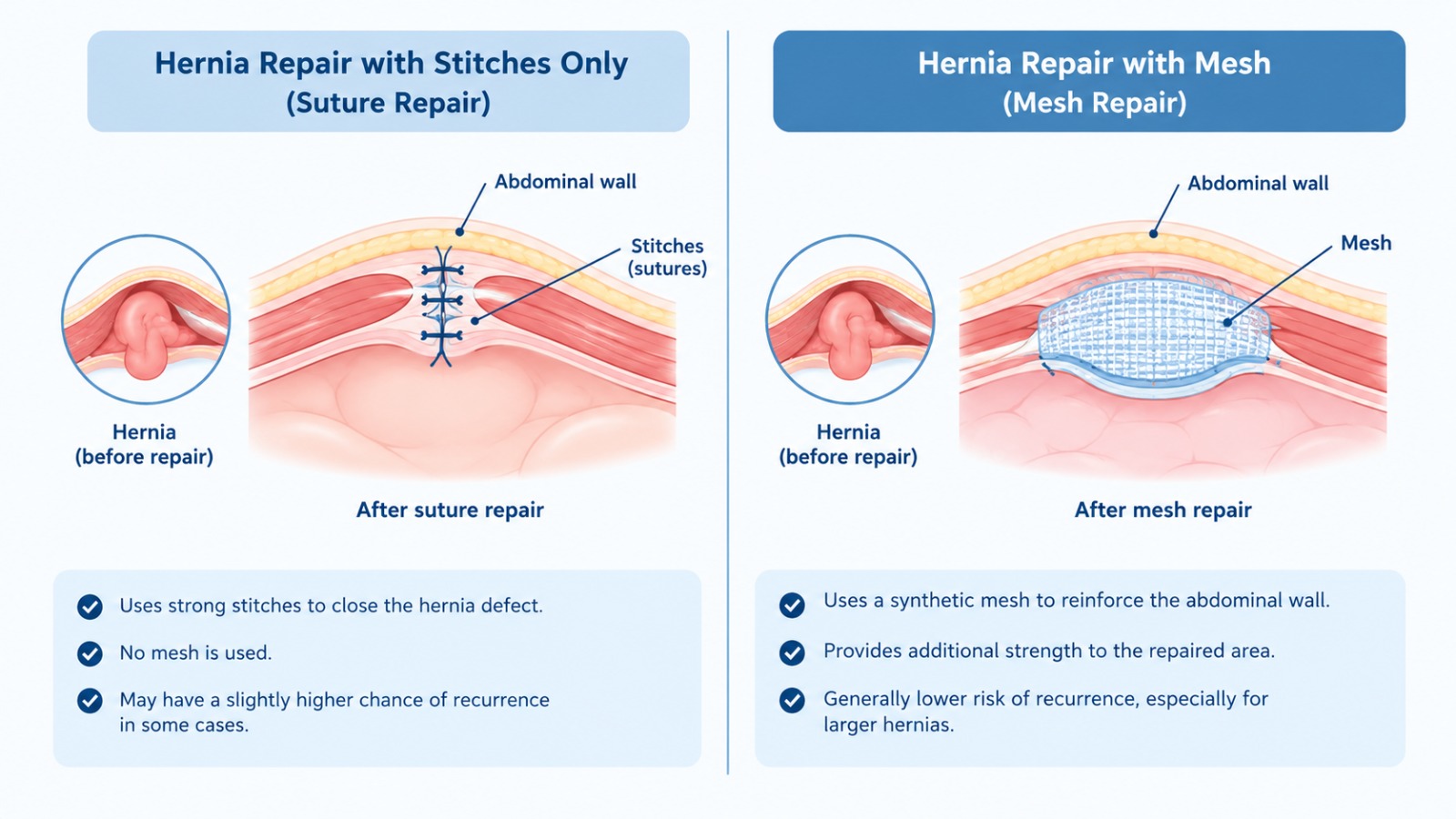
Types of Hernia Mesh
Not all meshes are the same. The surgeon chooses based on your hernia and the condition of the surrounding tissue.
| Mesh Type | What It Is | Where It Is Commonly Used |
| Lightweight synthetic mesh | Fine, soft, permanent net with large pores | Groin hernias and many routine repairs |
| Standard synthetic mesh | Stronger and denser permanent net | Larger hernias needing extra support |
| Coated mesh | Mesh with a special layer facing the intestine | Laparoscopic repairs placed inside the abdomen |
| Absorbable mesh | Breaks down slowly over time | Selected cases where a permanent implant is not preferred |
| Biologic mesh | Made from processed animal or human tissue | Infected or contaminated areas, in specific cases |
How Mesh Is Placed: Open vs Laparoscopic Repair
Open repair
The surgeon makes an incision over the hernia, returns the bulging tissue to its place and positions the mesh. It is a well-established method, and it is often used for larger or complicated hernias.
Laparoscopic repair
Here the surgeon uses a camera and a few small cuts to place the mesh from inside. Patients often have less pain after surgery and return to routine activity sooner, although the best method depends on the hernia and on the patient. Our article on laparoscopic hernia repair explains the steps in detail, and our guide to the benefits, risks and recovery of laparoscopic surgery covers what to expect afterwards.
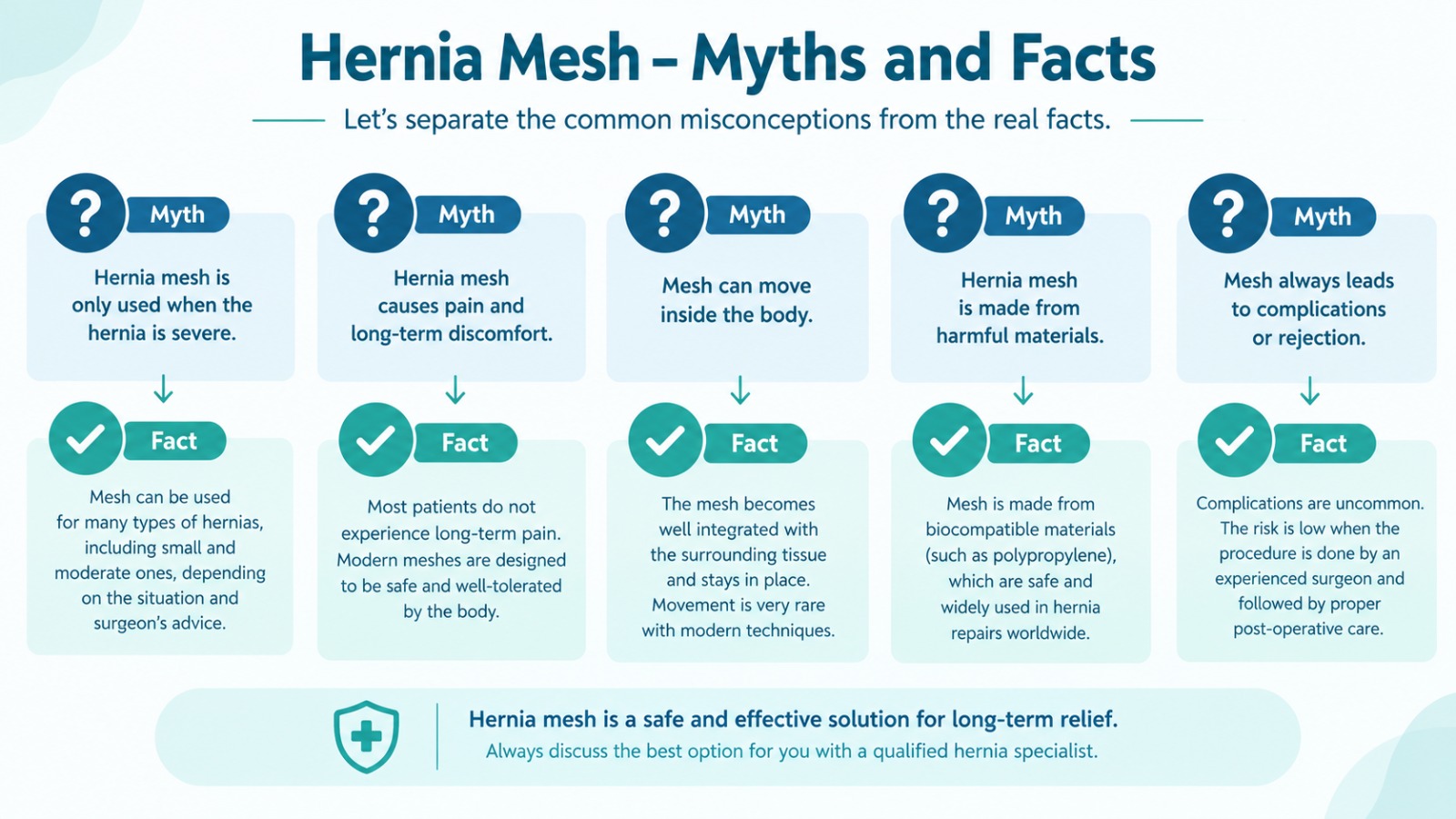
Is Hernia Mesh Safe? Common Myths and Facts
Much of the frightening news about mesh comes from a different product, the mesh used for pelvic organ prolapse repair in women. That is a separate device used in a different part of the body. Hernia mesh has a long track record, but it is fair to understand both the benefits and the risks.
| Common Belief | What Is Closer to the Truth |
| "The body rejects mesh like a transplanted organ" | Mesh is not rejected in that way, and the body usually grows tissue into it |
| "Mesh will set off metal detectors" | Most hernia meshes are plastic-like and not metal |
| "No mesh is always safer" | Avoiding mesh can raise the chance of the hernia returning |
| "Mesh always causes pain" | Most people are comfortable, though a small number have long-term pain |
| "Mesh dissolves later" | Most hernia meshes are permanent |
The possible complications include wound infection, fluid collection called a seroma, long-term pain and, in rare cases, the mesh sticking to nearby tissue. A hernia can also return even after a good repair. If you want to know more about long-term discomfort, read our article on chronic pain after hernia surgery.
How to Lower Your Risk Before Surgery?
Your own habits influence how well a repair heals. Before a planned operation, it helps to:
- Stop smoking well in advance, because it slows healing and raises the chance of infection
- Keep blood sugar controlled if you have diabetes
- Work towards a healthier weight if your surgeon advises it
- Treat a long-standing cough or constipation, which strain the repair
- Avoid heavy lifting before surgery and follow all instructions on fasting and medicines
Frequently asked questions
Is mesh necessary for hernia surgery?+
Is hernia mesh safe?+
Can a hernia be repaired without mesh?+
Is hernia mesh permanent?+
Can hernia mesh cause pain?+
How long is recovery after hernia mesh surgery?+
Do women also need mesh for a hernia?+
Conclusion
Mesh is neither the villain it is sometimes made out to be nor a magic fix. For most adult hernias, it gives a stronger repair and a lower chance of recurrence, and in skilled hands the risks are small. What matters most is the right decision for your hernia, made after a proper examination and an honest conversation. Ask questions, prepare your body for surgery and follow the recovery advice carefully. If you want a clear explanation of your own options, you can contact us to book a consultation. At Tirtham Surgical Hospital, we take the time to explain every step of hernia surgery in Ahmedabad, so that you feel confident about your treatment.
Next step
Plan your consultation
Share your reports on WhatsApp for a guided opinion, or visit us on Science City Road for an in-person examination.