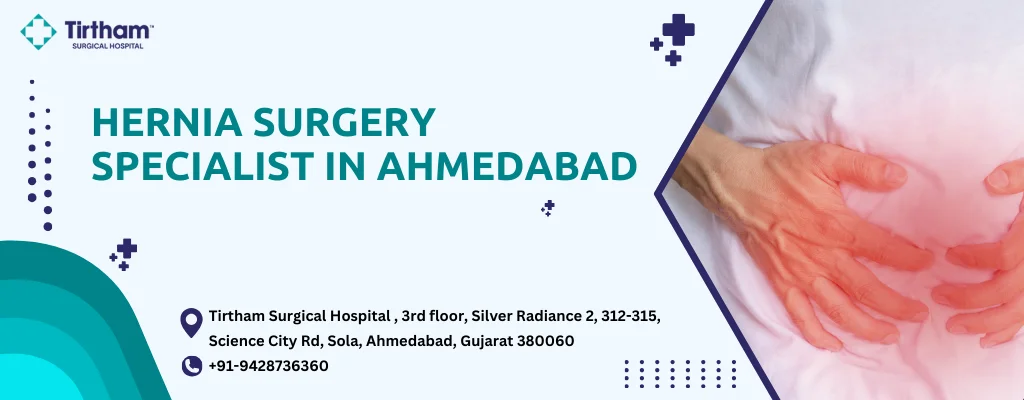
A hernia is a bulge where an organ or tissue pushes through a weak spot in the muscle wall most often in the groin or around the navel. It won't heal by itself, but that doesn't mean it always needs operating on today. The real goal of good hernia surgery in Ahmedabad isn't just to close the gap; it's to repair it so it holds for good and doesn't come back.
At Tirtham Surgical Hospital on Science City Road, most hernias are repaired with a tension-free mesh technique, usually by keyhole (laparoscopic) surgery, small cuts, less pain, and many patients home the same day or the next. Below is a straight guide to the types of hernia, when repair is genuinely needed, how it's done, what recovery and cost look like, and the warning signs that make a hernia an emergency.
What a hernia is and why it won't heal on its own
Picture the abdominal muscle wall as a firm net holding your organs in place. A hernia is a weak point in that net through which fatty tissue or a loop of bowel pushes out, creating a bulge you can often see or feel one that may appear when you cough, lift or strain, and disappear when you lie down.
Because muscle doesn't knit a hole like this back together, a hernia doesn't resolve on its own and tends to enlarge slowly over time. Surgery is the only way to actually repair it. The good news is that a well-done repair reinforcing the weak area with mesh has a low chance of coming back.
Why do hernias happen?
Hernias form where muscle is weak and pressure is high. Common contributors are heavy lifting or straining, a chronic cough, constipation, being overweight, pregnancy, ageing muscle, and a previous abdominal incision (which can weaken the wall). Some people are simply born with a weaker spot. Often it's a mix and it isn't something you did "wrong."
The common types of hernia
Where the bulge is tells you a lot about the hernia and how it's best repaired.
| Type | Where it is | Worth knowing |
| Inguinal | Groin | The most common type; more frequent in men |
| Femoral | Upper thigh / below the groin crease | More common in women; higher risk of strangulation, so usually repaired |
| Umbilical | At or near the navel | Common in adults with a weak abdominal wall (and in children) |
| Incisional | Site of a previous surgery | Occurs where a past incision has weakened; can be larger/complex |
| Hiatal (hiatus) | Stomach through the diaphragm | Causes acidity/reflux rather than a visible bulge → Hiatus hernia & fundoplication |
Symptoms and the signs that mean act now
Most hernias announce themselves as a bulge with some discomfort. The symptoms to take seriously are the ones that suggest the hernia is getting trapped.
- A visible bulge in the groin, abdomen or navel that comes and goes
- Aching, dragging or pressure, worse on coughing, lifting or bending
- A burning or heavy sensation at the bulge
- For hiatal hernias: heartburn, reflux, sometimes chest discomfort
- Warning signs seek care urgently: a bulge that suddenly becomes hard, painful and won't push back in, especially with nausea, vomiting or fever. This can mean the hernia is trapped (incarcerated) or its blood supply is cut off (strangulated) an emergency needing surgery within hours.
Do you actually need surgery yet?
Not every hernia needs immediate repair and an honest surgeon will say so. The decision depends on the type, your symptoms, and the risk of complications.
| Your situation | Usual approach |
| Small, painless, reducible hernia (pushes back in), low activity | "Watchful waiting" can be reasonable but many enlarge and are repaired eventually |
| Symptomatic hernia (pain, growing, limiting activity) | Planned repair is usually advised |
| Femoral hernia, or one that's hard to push back | Repair advised even if mild, because of strangulation risk |
| Sudden hard, painful bulge with vomiting/fever | Emergency surgery within hours to save the bowel |
The reason symptomatic and femoral hernias are repaired promptly is simple: planned keyhole surgery is far easier and safer than emergency surgery for a strangulated hernia.
How a hernia is diagnosed
Most hernias are diagnosed on a simple physical examination; a hernia doctor in Ahmedabad can usually feel the bulge and its behaviour when you cough or strain. When the diagnosis is unclear, or the hernia is deep or recurrent, an ultrasound, CT or MRI confirms it and shows its size and contents. That mapping matters, because it guides whether open or laparoscopic repair suits you best.
How hernia surgery is done laparoscopic vs open
Every modern repair reinforces the weak spot with mesh; the difference is how the surgeon gets there. The right choice depends on the hernia, not on which sounds most advanced.
| Laparoscopic (keyhole) | Open | |
| Incisions | 3–4 small cuts, mesh placed from inside | One incision over the hernia, mesh placed to reinforce |
| Typical stay | Day-care or 1 day | Day-care to 1–2 days |
| Pain & scarring | Less pain, smaller scars | Slightly more, one larger scar |
| Best suited to | Bilateral or recurrent inguinal hernias, active patients | Many single hernias; large/complex or scarred fields; when anaesthesia risk favours it |
| Return to routine | Often ~1–2 weeks | ~3–4 weeks for heavier activity |
National guidance (NICE) supports the laparoscopic approach particularly for bilateral and recurrent inguinal hernias, where it offers a quicker return to activity. Your surgeon will recommend whichever route is safest and most durable for your specific hernia.
What about mesh?
For most adult hernias, a soft synthetic mesh is the standard of care because it reinforces the muscle wall and gives a materially lower recurrence rate than stitching muscle alone. Mesh is well established and safe for the large majority of patients; a small minority can have mesh-related discomfort, which is why the type and placement are chosen carefully for you. In select small hernias, a suture-only repair may still be appropriate.
Recovery, step by step
For an uncomplicated repair, you'll typically be up and walking the same day and home within a day. Expect to ease back onto normal activity over the first week (many return to desk work in about a week), and to avoid heavy lifting and strenuous exercise for roughly 2–4 weeks while the repair settles. Open repairs of larger hernias take a little longer. You'll get clear instructions on wound care, pain relief and the warning signs to watch for.
What hernia surgery costs in Ahmedabad
Cost depends mostly on the hernia type (a simple inguinal repair sits lower; large, incisional, bilateral or recurrent repairs higher), the technique (open, laparoscopic or robotic), the mesh used, room category and stay. As a general market range in Ahmedabad, hernia repair runs roughly ₹55,000–₹1,50,000 with straightforward inguinal repairs toward the lower end and complex or robotic repairs higher. This is a market range, not a Tirtham quote, and cashless mediclaim can significantly reduce what you actually pay.
Tirtham offers a mediclaim / cashless facility, and the Tirtham Health Card can be used toward consultations and reports. For a figure matched to your hernia type and cover, contact us or share your details on WhatsApp.
Meet your hernia surgery specialist Dr. Alpesh Patel
A hernia repair is only as good as how well it holds and that comes from matching the technique and mesh to the individual hernia. At Tirtham, that judgement rests with Dr. Alpesh Patel (MS), a General & Laparoscopic Surgeon with 18+ years of practice and 22,000+ successful surgeries, across inguinal, umbilical, incisional and recurrent hernias.
As a hernia surgeon in Ahmedabad, his approach is tailored, not one-size-fits-all: keyhole repair for bilateral or recurrent inguinal hernias where it clearly helps, open repair where that's more durable, careful mesh selection to keep recurrence low, and prompt emergency repair when a hernia becomes strangulated. → More about Dr. Alpesh Patel
Why patients choose Tirtham for hernia repair
A few honest reasons this is a dependable hernia hospital in Ahmedabad:
- Repairs built to last — appropriate mesh and technique to keep recurrence low.
- The right approach for your hernia — keyhole where it helps, open where it's more durable, explained either way.
- 24×7 cover for emergencies — a strangulated hernia is treated without waiting.
- Honest advice on watchful waiting — you won't be pushed toward surgery a small, painless hernia doesn't yet need.
- One accountable surgeon through diagnosis, repair and follow-up.
- Cashless mediclaim + a real cost conversation, and calm private recovery rooms.
Frequently asked questions
Do all hernias need surgery, and when should I see a hernia doctor in Ahmedabad?+
Not immediately. A small, painless, reducible hernia can sometimes be watched, though many enlarge and are repaired eventually. See a hernia doctor in Ahmedabad if the bulge is growing, painful, or limiting you — and urgently if it becomes hard and won't push back in. Femoral hernias are usually repaired promptly because of strangulation risk.
Which is better — laparoscopic or open hernia surgery?+
Neither is universally "better" — it depends on the hernia. Laparoscopic repair suits bilateral and recurrent inguinal hernias and active patients, with less pain and a quicker return to activity. Open repair is often ideal for single or larger hernias and scarred fields. An experienced surgeon recommends whichever gives you the safest, most durable result.
Is hernia mesh safe, and is it always used?+
For most adult hernias, mesh is the standard of care because it lowers the chance of the hernia coming back compared with stitching muscle alone. It's well established and safe for the large majority; a small minority experience mesh-related discomfort, so the type and placement are chosen carefully. Some small hernias can be repaired without mesh.
How long does recovery take, and when can I return to work?+
After an uncomplicated repair, most people go home the same day or the next, and return to light or desk work in about a week. Heavy lifting and strenuous exercise should be avoided for roughly 2–4 weeks while the repair settles. Laparoscopic recovery is generally quicker; larger open repairs take a little longer.
What does hernia surgery in Ahmedabad cost?+
As a general market range, hernia surgery in Ahmedabad runs roughly ₹55,000–₹1,50,000 — simple inguinal repairs toward the lower end, complex, bilateral, recurrent or robotic repairs higher. It varies with mesh type, room category and stay, and cashless mediclaim can reduce your out-of-pocket cost. Share your details for a figure matched to your case.
Can a hernia come back after surgery?+
It can, but modern mesh repair keeps the recurrence rate low. Recurrence is more likely with very large or recurrent hernias, ongoing heavy strain, chronic cough, obesity or smoking. Following your surgeon's advice on lifting and activity during recovery — and managing those risk factors — gives the repair the best chance of lasting.
What makes a good hernia hospital in Ahmedabad?+
A good hernia hospital in Ahmedabad offers experienced surgeons who do both laparoscopic and open repair, appropriate mesh options, quick imaging when needed, 24×7 cover for strangulation emergencies, cashless mediclaim, and clear post-operative guidance. The ability to tailor the technique to your hernia — rather than one method for everyone — matters most.
Who is a good hernia surgery specialist in Ahmedabad?+
A good hernia surgery specialist in Ahmedabad is a surgeon who repairs hernias regularly, chooses mesh and technique to keep recurrence low, and handles recurrent and emergency cases. At Tirtham, Dr. Alpesh Patel (MS) — 18+ years and 22,000+ surgeries — assesses, operates and follows up personally, and will honestly advise if your hernia can safely be watched.
Not sure what to do about your hernia?
If you've noticed a bulge and you're unsure whether it needs repairing now, share the details with us for a guided opinion. We'll tell you honestly whether to plan surgery or safely watch it. Call or WhatsApp +91-9428736360, or use the no-pressure second-opinion line, SurgiMitra +91-9974416665. If a hernia suddenly becomes hard and painful with vomiting, treat it as an emergency and reach the nearest facility straight away.
Next step
Plan your procedure
Share your reports on WhatsApp for a guided opinion, or visit us on Science City Road for an in-person examination.