If an ultrasound has shown gallstones, your first question is probably the right one: do I actually need surgery, or can I leave them alone? The honest answer is it depends on whether they're causing symptoms. Silent stones are often just watched. But once gallstones start causing pain or complications, removing the gallbladder is the definitive fix, and today that's usually a keyhole (laparoscopic) operation with a short recovery.
At Tirtham Surgical Hospital on Science City Road, gallbladder stone surgery in Ahmedabad is most often done as laparoscopic cholecystectomy with three or four small cuts, less pain, and many patients home the same day or the next. Below is a straight, practical guide to when surgery is needed, how it's done, what recovery and cost look like, and what life is like afterwards.
What gallstones are and why they cause trouble
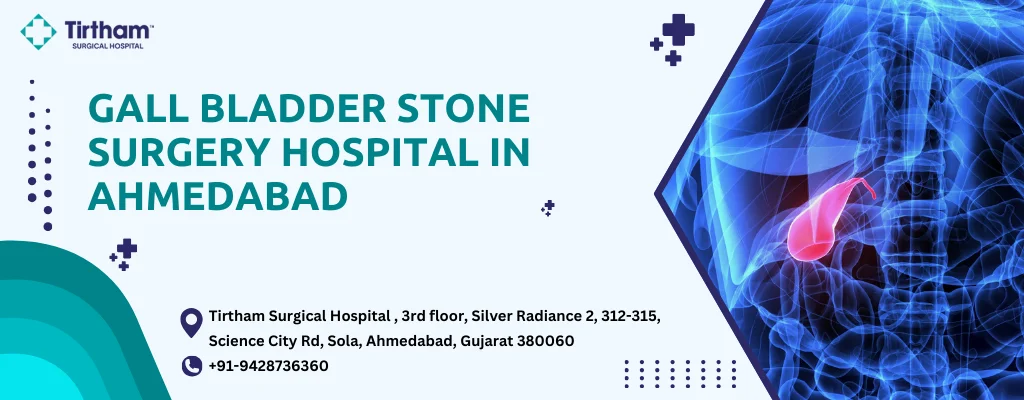
Your gallbladder is a small pouch under the liver that stores bile, a fluid that helps digest fat. Gallstones are hardened pieces of bile, mostly cholesterol, sometimes pigment that form inside it, ranging from grains of sand to a few centimetres across. Many people have them without ever knowing.
Problems start when a stone blocks the gallbladder's outlet or slips into the bile duct. That's when you get the classic attack: intense pain, often after a fatty meal. It's also how the more serious complications begin inflammation (cholecystitis), a blocked bile duct with jaundice, or pancreatitis.
Why do gallstones form?
The exact trigger isn't always clear, but stones tend to form when bile holds too much cholesterol for it to keep dissolved, when there's excess bilirubin, or when the gallbladder doesn't empty fully and bile becomes over-concentrated. Being female, older, overweight, pregnant, diabetic, or losing weight very rapidly all raise the odds but plenty of people with none of these still get them, so it isn't your fault.
Symptoms, and the warning signs that need quick attention
Gallstone pain (biliary colic) is typically felt in the upper-right or upper-middle abdomen, can spread to the back or right shoulder blade, and often follows fatty food. Use this to judge urgency but any severe or feverish attack should be seen promptly.
| What you're feeling | What it may mean | What to do |
| Occasional upper-right pain after fatty meals, settles in a few hours | Uncomplicated gallstone attacks | See a surgeon to plan treatment |
| Frequent or worsening attacks, nausea, bloating, fatty-food intolerance | Symptomatic gallstones | Get assessed surgery is usually advised |
| Severe constant pain with fever/chills | Possible gallbladder infection (cholecystitis) | Urgent seek care promptly |
| Pain with yellowing of eyes/skin or dark urine | Possible bile-duct blockage (jaundice) | Urgent needs quick assessment |
| Severe upper-abdominal pain radiating to the back, vomiting | Possible pancreatitis | Emergency reach a facility now |
Do your gallstones actually need surgery?
Not every gallstone needs removing and a good surgeon will tell you so. The decision turns on symptoms and risk, not just the presence of stones on a scan.
| Your situation | Usual recommendation |
| Silent (no symptoms), low risk | Usually monitored, not operated |
| Symptomatic (pain, repeated attacks) | Laparoscopic gallbladder removal usually advised |
| Complicated (cholecystitis, jaundice, pancreatitis) | Surgery needed, sometimes with an extra bile-duct step |
| Silent but high-risk (e.g. diabetic, very large stones, porcelain/calcified gallbladder, immunocompromised) | Surgery may be advised even without symptoms, to prevent complications |
The reason symptomatic stones are usually removed is that attacks tend to recur and can escalate and elective keyhole surgery is far easier and safer than emergency surgery for a complication.
How gallstones are diagnosed
Diagnosis is usually quick. An abdominal ultrasound is the main test; it reliably shows stones and gallbladder wall changes. A gallbladder stone doctor in Ahmedabad may add blood tests (to check for infection, jaundice or pancreatitis) and, if a bile-duct stone is suspected, an MRCP scan or endoscopic ultrasound (EUS). These extra tests matter because a stone hiding in the bile duct changes the plan it often needs clearing before or during gallbladder removal.
How gallbladder stone surgery is done laparoscopic vs open
Gallbladder removal is a cholecystectomy, done under general anaesthesia. Laparoscopic is the standard route today; open is reserved for specific situations.
| Laparoscopic (keyhole) | Open | |
| Incisions | 3–4 small cuts | One larger cut under the right ribs |
| Typical stay | Day-care or 1 day | 2–4 days |
| Pain & scarring | Less pain, tiny scars | More pain, a larger scar |
| Return to routine | ~1 week for light work | Slower |
| When it's chosen | Most cases | Severe inflammation, dense scarring, bleeding risk, or if keyhole becomes unsafe mid-surgery |
During laparoscopic surgery, the gallbladder stone surgeon in Ahmedabad inflates the abdomen with gas, inserts a camera and fine instruments through the small cuts, carefully identifies and seals the artery and bile duct to the gallbladder, and removes the whole gallbladder (stones and all). Removing the gallbladder, not just the stones is deliberate: it prevents new stones from forming.
When bile-duct stones are involved (ERCP)
If a stone has moved into the common bile duct, it's usually cleared by ERCP (an endoscopic procedure through the mouth, no external cut), either shortly before or alongside gallbladder removal. → CBD (bile-duct) stone treatment · Upper GI endoscopy
When open surgery is the safer choice
Sometimes, part-way through keyhole surgery, dense inflammation or unclear anatomy makes open surgery the safer option. Converting isn't a complication, it's good judgement that protects the bile duct. Your surgeon will always prioritise safety over keeping it keyhole.
Recovery and living well without a gallbladder
For an uncomplicated laparoscopic cholecystectomy, recovery is usually straightforward.
| When | What usually happens |
| Surgery day | ~45–60 min procedure; rest, sips of fluid, short walk; many go home the same day |
| Day 1–3 | Home; light meals; gentle walking; some shoulder-tip ache from the gas, which settles |
| Week 1 | Back to a normal diet gradually; many resume desk/light work |
| Weeks 2–4 | Avoid heavy lifting and hard exercise; most return to full activity |
Life without a gallbladder is normal. Bile simply flows straight from the liver into the intestine instead of being stored. Some people notice looser stools or mild fat intolerance for a few weeks usually helped by easing back onto fatty foods and eating smaller meals and it settles for most. There's no long-term special diet, and no essential function is lost.
What gallbladder stone surgery costs in Ahmedabad
Cost depends on the technique (laparoscopic vs open vs robotic), whether the gallbladder is badly inflamed, whether a bile-duct (ERCP) step is needed, your room category and length of stay. As a general market range in Ahmedabad, laparoscopic gallbladder stone surgery in private hospitals runs roughly ₹70,000–₹1,60,000; open surgery is often lower, and robotic surgery is considerably higher. This is a market range, not a Tirtham quote, a straightforward day-care case and a complicated one sit at different ends, and cashless mediclaim can significantly reduce what you actually pay.
Tirtham offers a mediclaim / cashless facility, and the Tirtham Health Card can be used toward consultations and reports. For a figure matched to your ultrasound and health cover, contact us or share your reports on WhatsApp.
Meet your gallbladder stone surgery specialist Dr. Alpesh Patel
Gallbladder surgery is common, but doing it safely every time is a skill the bile duct sits close to the gallbladder, and protecting it is what separates routine from risky. At Tirtham, that's the work of Dr. Alpesh Patel (MS), a General & Laparoscopic Surgeon with 18+ years of practice and 22,000+ successful surgeries, of which laparoscopic cholecystectomy is one of the most frequently performed.
As a gallbladder stone surgery specialist in Ahmedabad, his approach is careful and unhurried: confirm the stones are genuinely causing the problem, map the anatomy precisely before dividing anything, coordinate ERCP when a bile-duct stone is involved, and convert to open surgery without hesitation if that's safer on the day. → More about Dr. Alpesh Patel
Why patients choose Tirtham for gallbladder surgery
A few honest reasons this is a dependable gallbladder stone hospital in Ahmedabad:
- Keyhole-first, often day-care — most uncomplicated cases go home the same day or the next.
- Bile-duct safety taken seriously — precise anatomy, ERCP coordination when needed, open conversion when safer.
- One accountable surgeon through diagnosis, surgery and follow-up.
- Honest advice on silent stones — you won't be pushed toward surgery you don't need.
- Cashless mediclaim + a real cost conversation — no invented numbers.
- Calm, private recovery rooms to heal in.
Frequently asked questions
Who is a good gallbladder stone surgery specialist in Ahmedabad?+
A good gallbladder stone surgery specialist in Ahmedabad is an experienced laparoscopic surgeon who performs cholecystectomy regularly and protects the bile duct carefully. At Tirtham, Dr. Alpesh Patel (MS) — 18+ years and 22,000+ surgeries — assesses, operates and follows up personally, and will coordinate an ERCP if a bile-duct stone is also involved.
When is gallbladder stone surgery actually needed?+
Surgery is usually advised when gallstones cause symptoms — repeated pain, nausea, or complications like infection, jaundice or pancreatitis. Silent stones with no symptoms are often just monitored. A gallbladder stone doctor in Ahmedabad may still advise surgery for high-risk silent stones (for example in diabetics or a calcified gallbladder) to prevent future complications.
Can gallstones be treated without surgery?+
Silent, symptom-free stones may simply be watched. But there's no reliable way to "dissolve" symptomatic gallstones — dissolving medicines work slowly, only for certain small cholesterol stones, and stones usually return. For gallstones that cause pain or complications, laparoscopic removal of the gallbladder is the definitive, one-time solution.
Is laparoscopic gallbladder surgery safe?+
Laparoscopic cholecystectomy is one of the most commonly performed and well-established operations, with smaller incisions, less pain and quicker recovery than open surgery. No surgery is entirely without risk, and occasionally an operation is safely converted to open. Choosing an experienced surgeon who prioritises bile-duct safety is the most important factor.
How long does recovery take after gallbladder surgery?+
After an uncomplicated laparoscopic cholecystectomy, most people go home the same day or the next, return to a normal diet within days, and manage light work in about a week. Heavy lifting and strenuous exercise are best avoided for 2–4 weeks. Recovery is longer if the gallbladder was badly inflamed or surgery was open.
What does gallbladder stone surgery in Ahmedabad cost?+
As a general market range, laparoscopic gallbladder stone surgery in Ahmedabad's private hospitals runs roughly ₹70,000–₹1,60,000, depending on technique, how inflamed the gallbladder is, whether a bile-duct (ERCP) step is needed, room category and stay. Cashless mediclaim can reduce your out-of-pocket cost significantly. Share your reports for a figure matched to your case.
Can I live normally without a gallbladder?+
Yes. The gallbladder only stores bile; after removal, bile flows directly from the liver into the intestine and digestion carries on normally. Some people have looser stools or mild fat intolerance for a few weeks, usually eased by smaller, lower-fat meals at first. There's no long-term special diet and no lasting restriction.
What makes a good gallbladder stone hospital in Ahmedabad?+
A good gallbladder stone hospital in Ahmedabad offers experienced laparoscopic surgeons, quick access to ultrasound/MRCP and blood tests, the ability to manage bile-duct stones (ERCP) and convert to open safely, cashless mediclaim, and clear post-operative support. Day-care capability for uncomplicated cases is a bonus that shortens your hospital time.
Talk it through before you decide
If you've got an ultrasound showing gallstones and you're unsure what to do next, share it with us for a guided opinion. We'll tell you honestly whether surgery is needed now, can wait, or can be planned at your convenience. Call or WhatsApp +91-9428736360, or use the no-pressure second-opinion line, SurgiMitra +91-9974416665. If you're having a severe attack with fever or jaundice, please seek care promptly.
Next step
Plan your procedure
Share your reports on WhatsApp for a guided opinion, or visit us on Science City Road for an in-person examination.