

This guide answers it in simple words. You will learn how bowel control works, which fistulas carry more risk, and what your surgeon does to protect the muscle.
For most people, fistula surgery does not damage bowel control. The risk depends on how much of the anal muscle the fistula crosses. A simple, low fistula can be opened with very little effect on control. A fistula that crosses more muscle needs special muscle-saving techniques, sometimes in more than one stage. Your surgeon explains your own risk before the operation.
How Does Bowel Control Work?
Your anus is closed by two rings of muscle, called the sphincter muscles.
- The inner ring works on its own. It keeps the anus closed without you thinking about it.
- The outer ring works when you decide. You squeeze it to hold in gas or stool until you reach a toilet.
Together, these two muscles keep you dry and in control. If they are weakened or cut too much, gas or stool can leak out.
What does a fistula have to do with the muscle?
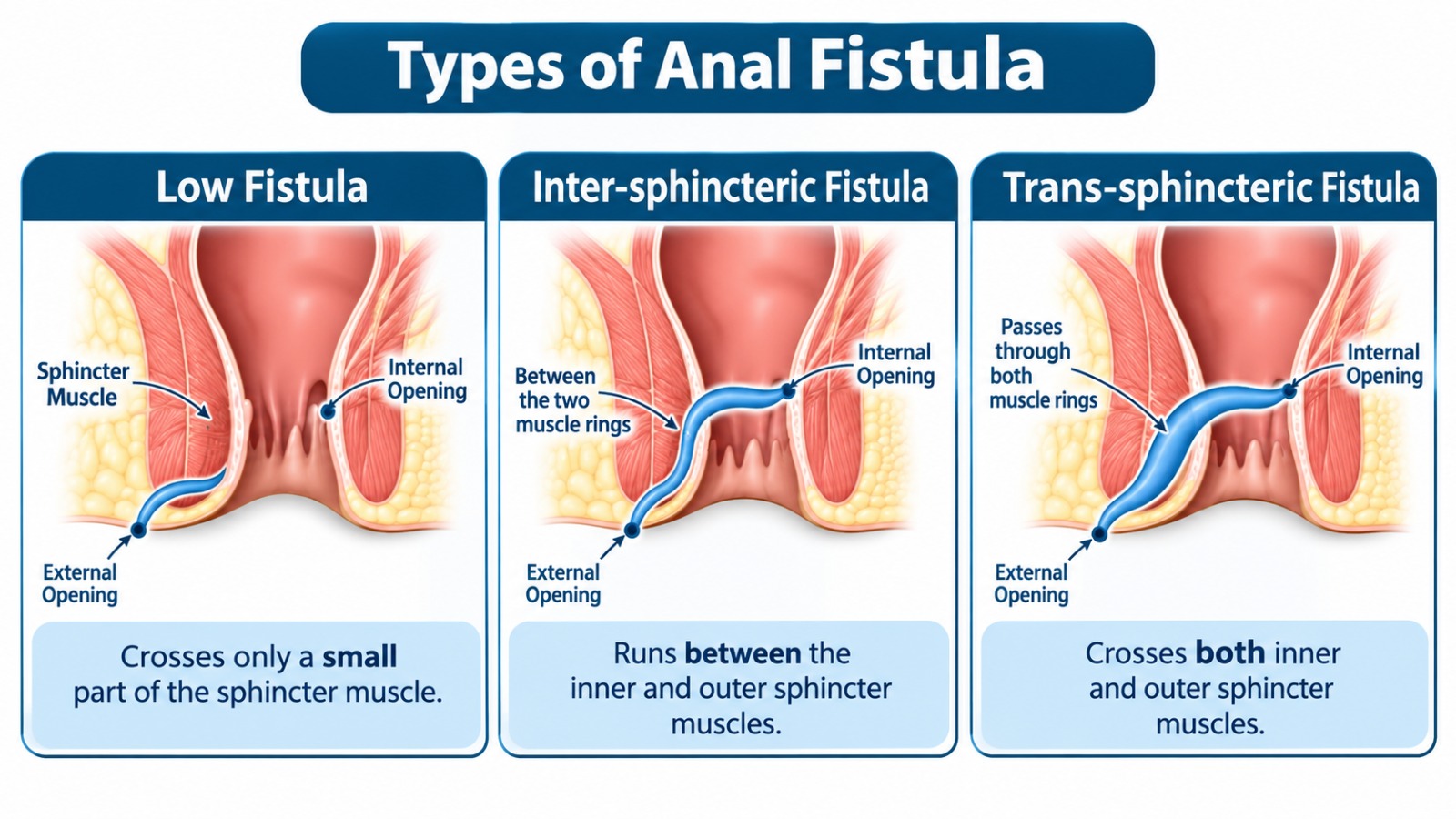
An anal fistula is a small tunnel between the inside of the anal canal and the skin near the anus. It usually starts after an abscess. Depending on where the tunnel runs, it may pass beside the muscle, between the two rings, or right through them. The more muscle it crosses, the more careful the surgery must be. You can read the basics on our page about fistula surgery in Ahmedabad.
Will Fistula Surgery Affect Bowel Control? It Depends on the Fistula
There is no single answer for everyone. The path of the tunnel decides the risk.
| Type of Fistula | How Much Muscle Is Involved | Usual Approach | Risk to Bowel Control |
| Simple, low fistula | Very little | Fistulotomy (tunnel opened along its length) | Low |
| Fistula between the two muscle rings | Only the inner ring is involved | Often fistulotomy | Low |
| Fistula going through both rings | A large part of the muscle | Seton, LIFT or flap | Depends on how much muscle is crossed |
| High or branching fistula | A large part of the muscle | Muscle-saving techniques, often in stages | Higher, so extra care is taken |
| Fistula linked to Crohn's disease | Varies | Medicines and a loose seton; no muscle-cutting operations | Protected by avoiding muscle cutting |
To understand how doctors group these tunnels, you can also read our article on cryptoglandular vs non-cryptoglandular fistulas.
How Surgeons Protect the Muscle
Every fistula operation has two goals: to heal the fistula and to protect the muscle. Surgeons plan carefully to do both.
Step 1: Map the tunnel before surgery
For complex, high or returning fistulas, your surgeon may ask for an MRI of the pelvis, called an MRI fistulogram, or an ultrasound from inside the anal canal. These tests show the full path of the tunnel, any hidden branches and how close it runs to the muscle. Without this map, the surgeon would be working blind.
Step 2: Choose a muscle-saving technique
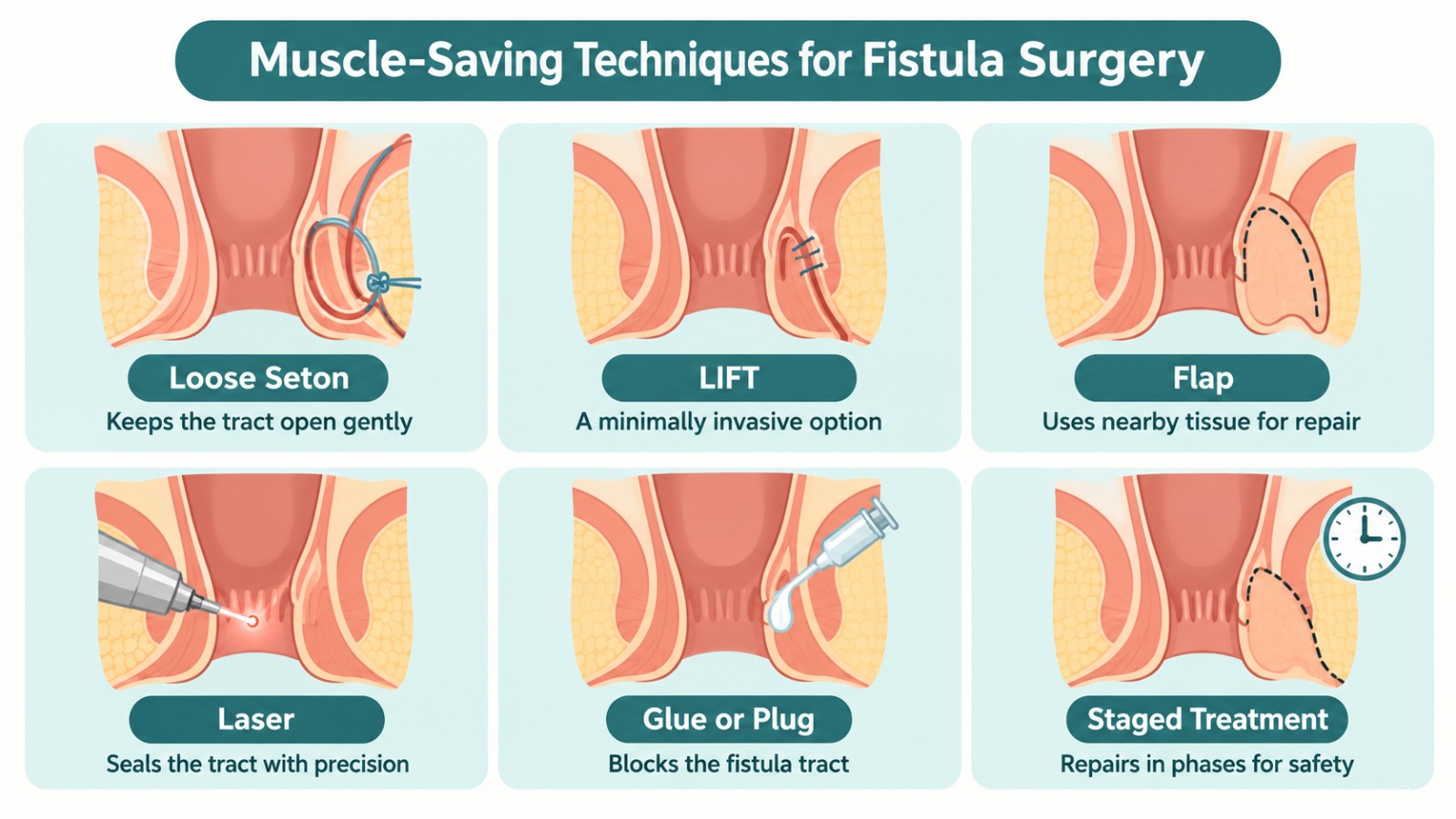
Modern surgery offers several ways to close a fistula without cutting much muscle.
| Technique | How It Protects the Muscle | Points to Know |
| Loose seton | A soft thread drains the tunnel and keeps it open without cutting | Often the first step in complex fistulas |
| Cutting seton | A thread slowly cuts through the muscle while it heals behind the thread | Needs careful planning, because it does involve muscle |
| LIFT | The tunnel is tied and divided between the two muscle rings | Saves the muscle; healing varies |
| Advancement flap | A flap of healthy tissue covers the inner opening | Saves the muscle; healing varies |
| Laser or video-assisted closure | The tunnel is closed from inside, without cutting muscle | Suitable for selected fistulas; healing rates vary |
| Fibrin glue or plug | The tunnel is filled to close it | Saves the muscle, but healing rates are lower |
The choice is not about which technique is the "newest." It is about which one fits the path of your tunnel. Our article on modern fistula treatment options explains more about how these methods compare.
Step 3: Treat in stages when needed
Some fistulas are too complex to fix in one go. In that case, the surgeon first drains the infection with a seton and lets the area settle. A second operation closes the tunnel later. Staged treatment can take longer, but it protects the muscle and often gives a better result.
What You May Notice After Surgery
Healing takes time, and some changes in the first weeks are normal.
| What You Notice | Is It Normal? | What to Do |
| Some discharge or spotting from the wound | Yes, during healing | Keep the area clean and use dressings as advised |
| Mild leakage of gas or mucus for a short time | Can happen in some people while swelling settles | Mention it at your follow-up visit |
| Difficulty passing urine | Usually temporary | Tell your surgeon the same day |
| Leakage of stool | Not expected | Contact the hospital |
| Fever, heavy bleeding or increasing pain | Not normal | Contact the hospital |
If you want to know when a fistula comes back after treatment, read about why a fistula keeps coming back.
What Raises the Risk to Bowel Control?
Not every patient has the same risk. Your surgeon looks at these points:
- A fistula that crosses a large part of the muscle
- A high or branching fistula
- A fistula that has returned after earlier surgery
- A fistula in the front of the body in women, where the muscle is thinner
- Earlier muscle weakness, for example after childbirth injury or earlier anal surgery
- Fistulas linked to conditions such as Crohn's disease or tuberculosis
These points do not mean you will lose control. They mean your surgeon will choose a gentler technique, and may plan the treatment in stages.
How You Can Protect Your Bowel Control
You also play a part. A few habits help the area heal well:
- Eat a high-fibre diet and drink plenty of water, so stools stay soft
- Use stool softeners as advised, and avoid straining
- Take warm-water sitz baths 2 to 3 times a day, and after passing stool
- Keep your blood sugar under control if you have diabetes, because high sugar slows healing
- Avoid smoking, which delays healing
- Ask your surgeon about gentle pelvic floor exercises, and begin them only when advised
- Go to every follow-up visit, even if you feel well
Questions to Ask Your Surgeon
A good consultation makes you feel sure about the plan. Before surgery, ask:
- Is my fistula simple or complex, and how much muscle does it cross?
- Do I need an MRI fistulogram or an ultrasound before surgery?
- Which technique suits my fistula, and why?
- What is my own risk to bowel control?
- Will my treatment be done in one stage or more?
- What changes should make me call you straight away?
If you are looking for a fistula surgeon in Ahmedabad, you can read about Dr. Alpesh Patel and the anorectal surgery he performs.
Frequently asked questions
Will fistula surgery affect my bowel control?+
Can fistula surgery cause incontinence?+
Which fistula surgery is best to save the muscle?+
Is a seton safe for bowel control?+
Is gas leakage after fistula surgery normal?+
Why do some fistulas need more than one operation?+
Can I avoid surgery to protect my bowel control?+
Conclusion
Fear of losing bowel control is natural, but it should not make you delay treatment. A fistula rarely heals on its own, and waiting can lead to repeated abscesses and a more complex tunnel. With careful mapping, the right muscle-saving technique and staged treatment where needed, most people recover with their bowel control intact. Ask your questions openly, follow the care advice and keep your follow-up visits. If you want a clear opinion about your own fistula, you can contact us to book a consultation.
At Tirtham Surgical Hospital, we explain your fistula, your options and your risks in plain words, so you can decide without fear.
Next step
Plan your consultation
Share your reports on WhatsApp for a guided opinion, or visit us on Science City Road for an in-person examination.