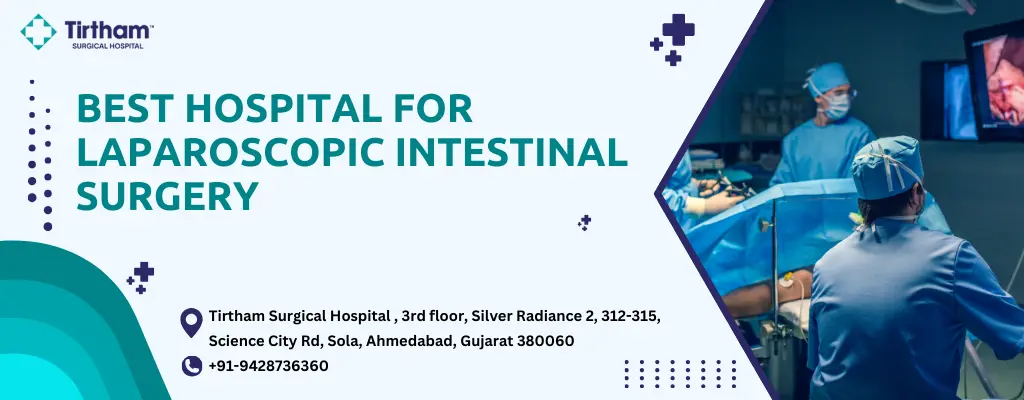
For suitable patients, this surgery can be performed laparoscopically (keyhole surgery) through a few small incisions instead of one long cut. Compared with open surgery, laparoscopic bowel surgery generally means less pain, fewer wound problems, a shorter hospital stay and a quicker return to daily activity. Bowel surgery is still major surgery, and the choice of technique depends on the condition, previous operations and the patient's overall health.
Tirtham Surgical Hospital, Science City Road, Sola, Ahmedabad, provides laparoscopic and open intestinal surgery, with a 24-hour emergency operating team. This page explains, step by step, the conditions treated, how the operation is done, the question of a stoma, recovery, risks and cost factors — so that patients and families can discuss their care clearly with the treating surgeon.
Laparoscopic Intestinal Surgery in Ahmedabad at a Glance
The information below describes a typical planned laparoscopic bowel resection. Every patient is different, and the treating surgeon will explain what applies to you.
| Item | Typical information |
| Procedure names | Bowel resection; colectomy (large bowel); small bowel resection; adhesiolysis (division of adhesions) |
| Technique | Laparoscopic (keyhole) through 4–5 small incisions, with one slightly longer incision to remove the bowel segment; open surgery when safer |
| Anaesthesia | General anaesthesia |
| Usual operation time | About 2–4 hours for a bowel resection; shorter for adhesiolysis |
| Usual hospital stay | About 3–5 days after planned laparoscopic resection; longer after open or emergency surgery |
| Return to desk / light work | Often around 2–3 weeks |
| Return to heavy activity | Usually after 6 weeks or more, as advised by the surgeon |
| Emergency services at Tirtham | 24-hour emergency operating team |
| Insurance | Mediclaim and cashless facility available, subject to policy terms |
What Is Laparoscopic Intestinal Surgery?
The intestine has two main parts. The small intestine absorbs nutrients from food. The large intestine — the colon and rectum — absorbs water and stores stool until it is passed.
In laparoscopic intestinal surgery, the surgeon passes a laparoscope (a thin camera) and fine instruments through small incisions in the abdomen. The abdomen is gently filled with carbon dioxide gas to create working space, and a magnified image is shown on a screen. The surgeon frees the diseased segment of bowel, removes it through a small incision, and joins the healthy ends together. This join is called an anastomosis.
The same keyhole approach may also be used to divide bands of scar tissue (adhesions), remove a Meckel's diverticulum, or examine the bowel when the cause of a problem is unclear.
Related page: Small & large bowel surgery
Conditions That May Need Intestinal Surgery
Many bowel conditions are first treated with medicines or endoscopic procedures. Surgery is considered when these are not suitable or not effective, or when there is a complication.
| Condition | Why surgery may be needed | What the operation usually involves |
| Colon or rectal cancer | To remove the tumour | Removal of the affected segment with a margin of healthy bowel and the nearby lymph nodes |
| Crohn's disease | Narrowing (stricture), fistula or abscess not controlled by medicines | Removal of the diseased segment, or widening of a narrowed segment (strictureplasty) |
| Ulcerative colitis | Disease not controlled by medicines, or a serious complication | Removal of the colon, sometimes with construction of an internal pouch |
| Diverticular disease | Repeated attacks of inflammation, abscess, fistula or narrowing | Removal of the affected segment, often the sigmoid colon |
| Intestinal obstruction | Blockage from adhesions, hernia, tumour or twisting of the bowel | Division of adhesions or removal of the blocked segment |
| Intestinal perforation | A hole in the bowel wall causing infection in the abdomen | Repair of the hole or removal of the affected segment |
| Meckel's diverticulum | Bleeding, inflammation or blockage | Removal of the diverticulum, sometimes with a small bowel segment |
| Benign tumours and large polyps | Growths that cannot be removed safely by endoscopy | Removal of the bowel segment containing the growth |
| Intestinal tuberculosis | Narrowing or blockage despite medicines | Removal of the narrowed segment or relief of the blockage |
Related pages: Lap hemicolectomy for colon cancer · Lap APR for rectal cancer · Intestinal obstruction · Intestinal perforation · Meckel's diverticulum
Symptoms That Need Medical Evaluation
These symptoms do not always mean a serious condition, but they should be evaluated by a doctor:
- Blood in the stool, or black stools
- A lasting change in bowel habit — constipation, loose motions or narrower stools
- Abdominal pain, cramps or bloating that keeps returning
- Unexplained weight loss or loss of appetite
- Tiredness or breathlessness from anaemia (low haemoglobin)
- A lump in the abdomen
- Vomiting with a swollen belly and inability to pass gas or stool — this needs emergency care
Deciding Whether Bowel Surgery Is Needed
Step 1: Medical History and Examination
The doctor asks about symptoms, their duration, weight loss, family history of bowel disease or cancer, previous operations and current medicines, and examines the abdomen.
Step 2: Tests
- Blood tests: blood count, liver and kidney function, and other tests as required
- Colonoscopy: to look inside the large bowel and take biopsies
- CT scan of the abdomen (and chest when needed): to see the extent of disease and plan surgery
- MRI of the pelvis: for rectal cancer and some cases of Crohn's disease
- Tumour marker (CEA): in bowel cancer, as a baseline for follow-up
- Biopsy results: to confirm the diagnosis before planned surgery
Step 3: Treatment Plan
After assessing all findings, the surgeon explains whether surgery is needed, the type of operation, whether laparoscopic or open surgery is suitable, whether a stoma may be needed, and the expected recovery. For cancer, the plan may include treatment by an oncologist before or after surgery.
Laparoscopic vs Open Intestinal Surgery
Both methods remove the same diseased bowel and join the healthy ends. The difference is how the surgeon reaches the bowel.
| Feature | Laparoscopic (keyhole) surgery | Open surgery |
| Incisions | 4–5 small incisions and one small extraction incision | One longer incision on the abdomen |
| Usual hospital stay | About 3–5 days after planned surgery | About 5–7 days or more |
| Pain after surgery | Generally less | Generally more |
| Wound problems (infection, hernia) | Generally fewer | Generally more |
| Return of bowel function | Often quicker | Often slower |
| Return to activity | Generally quicker | Generally slower |
| Commonly chosen for | Many planned operations for cancer, Crohn's disease and diverticular disease | Severe inflammation, dense adhesions, very large tumours, some emergencies, or when laparoscopy is not safe |
Laparoscopic Surgery for Bowel Cancer
Large international clinical trials have shown that, for suitable patients with colon cancer, laparoscopic surgery gives cancer outcomes comparable to open surgery, along with a quicker recovery. Whichever approach is used, the same principles of cancer surgery apply: removal of the tumour with a margin of healthy bowel and removal of the nearby lymph nodes. Laparoscopic surgery is not suitable for every patient, and the surgeon will explain which approach is recommended for your case.
Will I Need a Stoma?
A stoma is an opening of the bowel on the surface of the abdomen. Stool passes through it into a bag worn on the skin. An ileostomy is made from the small intestine, and a colostomy from the large intestine.
| Situation | What usually happens |
| Most planned bowel resections | The healthy ends are joined directly and no stoma is needed |
| Join made low in the rectum, or after radiotherapy | A temporary stoma may be made to protect the join while it heals |
| Emergency surgery with infection or a poorly prepared bowel | A temporary stoma may be safer than joining the bowel immediately |
| Some very low rectal cancers involving the anal muscles | A permanent colostomy may be needed |
A temporary stoma is usually closed with a smaller operation after the join has healed, often after a few months, or after chemotherapy is completed. If a stoma is possible in your case, the surgeon explains this before surgery, including how a stoma is cared for.
Intestinal Operation in Ahmedabad: Step by Step
Before Surgery
- Consultation: the surgeon explains the diagnosis, the planned operation, the possibility of a stoma and the expected recovery
- Pre-anaesthesia check-up: blood tests, ECG, chest X-ray, and heart or lung tests if required
- Medicine check: blood thinners, diabetes medicines and other regular medicines are adjusted as advised
- Preparing the body: stopping smoking, improving nutrition, correcting anaemia and staying active help recovery
- Bowel preparation: some operations need medicines to clean the bowel, as advised by the surgeon
- Informed consent: the procedure, alternatives, stoma possibility, risks and the possibility of conversion to open surgery are explained in simple language
- Fasting: as advised by the anaesthetist before general anaesthesia
- Insurance formalities: cashless or reimbursement paperwork is started
For planned laparoscopic intestinal surgery in Ahmedabad, most of these steps are completed in the weeks and days before the operation; in emergency surgery, they are shortened to what is needed for a safe operation.
During Laparoscopic Bowel Resection
- General anaesthesia is given; the patient is asleep throughout the operation
- Small incisions are made for the camera and instruments
- The abdomen is gently filled with carbon dioxide gas to create working space
- The abdomen is examined to confirm the findings
- The diseased segment is freed and its blood vessels are sealed; in cancer surgery, the nearby lymph nodes are removed with it
- The segment is removed through a small extraction incision
- The healthy ends are joined with staples or stitches (anastomosis); a temporary stoma is made if needed
- The abdomen is checked for bleeding, and a drain is placed only if needed
- The gas is released and the incisions are closed
The removed bowel is sent for histopathology (laboratory examination under a microscope). This confirms the diagnosis and, in cancer, shows the stage of the disease, which guides further treatment.
After Surgery, in Hospital
- Pain relief medicines are given as required
- Patients are encouraged to sit out of bed and walk from the first day, which helps recovery and lowers the risk of clots and chest infection
- Sips of fluids are started early, followed by light food as the bowel begins working
- The urinary catheter and any drain are removed as recovery progresses
- Blood-thinning injections may be given to lower the risk of clots
- Discharge is planned once the patient is eating, walking, passing gas or stool and comfortable on oral medicines
This approach — early walking, early feeding and good pain control — is known as enhanced recovery and is widely used after bowel surgery.
Recovery After Intestinal Surgery
Typical Recovery Timeline
This timeline applies to a planned laparoscopic bowel resection. Recovery is longer after open or emergency surgery, when a stoma is made, or when further treatment such as chemotherapy follows. Individual recovery varies.
| Time after surgery | What usually happens |
| Day of surgery | Rest; gentle movement in bed; sips of fluid if advised |
| Day 1–3 | Walking; fluids then light food as the bowel starts working; catheter and drains removed as recovery progresses |
| Day 3–5 | Many patients are discharged once eating, walking and passing gas or stool |
| Week 2–3 | Home recovery; many people return to desk or light work |
| Week 4–6 | Gradual return to normal activity; avoid heavy lifting |
| After 6 weeks | Heavier activity and exercise as advised by the surgeon |
Diet After Surgery
- Start with small, frequent, light meals and increase gradually
- Chew food well and drink adequate fluids
- Bowel habits may change for some weeks after surgery and usually settle
- With an ileostomy, extra fluids and salt may be needed, as advised
- Specific diet advice is given based on the operation performed
Wound and Stoma Care
- Keep the dressings clean and dry until advised otherwise
- Bathing is usually allowed after 48 hours; pat the wounds dry
- If a stoma is made, care of the stoma and bag is taught before discharge
When to Contact the Hospital After Discharge
- Fever above 100.4°F (38°C) or shivering
- Abdominal pain or swelling that is getting worse instead of better
- Continuous vomiting or inability to keep fluids down
- No passing of gas or stool, or no output from the stoma
- Increasing redness, swelling, pus or discharge from any wound
- Bleeding from the back passage or the stoma
- Pain or swelling in the calf, chest pain or breathlessness
Patients receive written discharge instructions, a contact number for post-operative queries and a follow-up appointment date.
Risks and Possible Complications
Intestinal surgery is major surgery and carries more risk than smaller operations such as gallbladder or hernia surgery. Risks are higher in emergency surgery, in elderly patients and in people with other medical conditions. The surgeon discusses these risks before taking consent.
- Anastomotic leak — the join between the bowel ends does not heal fully and leaks; uncommon, but serious, and more likely when the join is low in the rectum. It may need antibiotics, drainage, further surgery or a stoma
- Bleeding — may need a blood transfusion or, rarely, further surgery
- Wound infection — less frequent after laparoscopy; treated with dressings and antibiotics
- Infection inside the abdomen — may need antibiotics and drainage
- Delayed return of bowel function (ileus) — causes bloating and vomiting, and delays eating for some days
- Blood clots in the legs or lungs — reduced by early walking and blood-thinning injections
- Chest or urinary infection
- Injury to nearby organs such as the ureter (urine tube), bladder or other parts of the bowel — rare
- Hernia at an incision or stoma site — may occur later
- Adhesions that can cause blockage in the future
- Stoma-related problems, such as skin irritation, narrowing or hernia, when a stoma is made
- Conversion from laparoscopic to open surgery — in a proportion of cases
- Return of the disease — for example, recurrence of cancer or Crohn's disease, which is why follow-up is important
- Anaesthesia-related risks — assessed at the pre-anaesthesia check-up
Intestinal Surgery Cost in Ahmedabad
Intestinal surgery covers many different operations, from division of adhesions to major cancer surgery, so the cost differs widely from patient to patient. The main factors are:
- The type of operation and the length of bowel removed
- Laparoscopic or open technique
- Whether the surgery is planned or an emergency
- Whether a stoma is made, and later stoma closure
- Investigations required, such as colonoscopy, CT or MRI
- Length of hospital stay, room category, and intensive care if needed
- Medicines, blood transfusion and histopathology
A written estimate based on the patient's diagnosis and chosen room category can be requested from the hospital.
Insurance
- Mediclaim and cashless facility is available, subject to the patient's policy terms and insurer approval
- Assistance is provided with documents required for reimbursement claims
Laparoscopic Intestinal Surgery Doctor in Ahmedabad
Bowel surgery is a major operation, so it is reasonable to ask your laparoscopic intestinal surgery doctor in Ahmedabad a few clear questions before giving consent. The answers help you understand the plan, the recovery and the possibility of a stoma.
- What is the diagnosis, and has it been confirmed by colonoscopy, biopsy or CT scan?
- Which part of the bowel will be removed, and will the healthy ends be joined in the same operation?
- Is laparoscopic surgery suitable for me, and when might it be changed to open surgery?
- Is there a chance of a stoma, and will it be temporary or permanent?
- Do I need bowel preparation, nutrition support or correction of anaemia before surgery?
- If this is cancer, will I need chemotherapy or radiotherapy, and who will plan it?
- How long will I stay in hospital, and when can I return to work?
- What does the estimate include, and is the treatment covered by my insurance policy?
Laparoscopic Intestinal Surgeon in Ahmedabad
Bowel resection is performed by a qualified surgeon, usually one with a postgraduate degree in general surgery (MS or DNB) and training in laparoscopic surgery; some surgeons also have further training in colorectal surgery. When choosing a laparoscopic intestinal surgeon in Ahmedabad, these points are worth checking:
| What to check | Why it matters | How to check |
| A postgraduate qualification in surgery | Bowel resection is major abdominal surgery | Ask the hospital, or look at the qualifications listed for the doctor |
| Registration with a medical council | Every practising doctor in India must be registered | Search the Gujarat Medical Council register or the National Medical Register |
| Laparoscopic bowel surgery | Keyhole surgery is suitable for many planned bowel operations | Ask whether laparoscopic bowel resection is routinely performed, and when open surgery is preferred |
| Availability in emergencies | Obstruction and perforation often need surgery at short notice | Ask whether an emergency operating team is available round the clock |
| Coordination with other doctors | Bowel cancer and Crohn's disease often need an oncologist or gastroenterologist as well | Ask how care is planned with these doctors |
| A clear explanation of options and risks | It supports an informed decision | The surgeon should explain the options, the risk of a leak, the chance of a stoma and the chance of conversion to open surgery |
Laparoscopic Intestinal Surgery Hospital in Ahmedabad
Because bowel surgery is major surgery and some bowel conditions are emergencies, the hospital should be able to investigate the problem, operate safely and monitor the patient closely afterwards. These are the facilities that matter most:
| Facility | Why it matters |
| 24-hour emergency surgical team | Intestinal obstruction and perforation often need surgery outside regular OPD hours |
| Operation theatre for laparoscopic and open surgery | Allows keyhole surgery, and a safe change to open surgery when needed |
| Access to CT scan, colonoscopy and laboratory tests | Confirms the diagnosis and helps plan the operation |
| Blood transfusion services | Bleeding during or after bowel surgery may need a transfusion |
| Anaesthesia services and intensive care when needed | Supports safe surgery and monitoring of high-risk or emergency patients |
| Post-operative ward care and stoma care teaching | Early walking, early feeding, watching for a leak, and teaching care of a stoma before discharge |
| Histopathology | Confirms the diagnosis and, in cancer, the stage that guides further treatment |
| Insurance assistance | Helps with cashless approval or reimbursement documents |
The facilities available at Tirtham Surgical Hospital are listed further below on this page.
Treating Surgeon
At Tirtham Surgical Hospital, laparoscopic intestinal surgery in Ahmedabad is performed by:
| Detail | Information |
| Name | Dr. Alpesh Patel |
| Qualification | MBBS, MS (Civil Hospital, Surat) |
| Specialty | General & Laparoscopic Surgery |
| Designation | Founder, Tirtham Surgical Hospital |
| Registration status | Registered Medical Practitioner |
| Registration number | Gujarat Medical Council Reg. No. G14657 |
| OPD availability | On appointment, Mon–Sat |
| Emergency surgical services | 24-hour emergency operating team at Tirtham Surgical Hospital |
Facilities at Tirtham Surgical Hospital
- 24-hour emergency operating team
- Laparoscopic and endoscopic setup
- Mediclaim and cashless facility, subject to policy terms
- 6 themed recovery rooms
- Large parking facility
Frequently asked questions
When should I see a laparoscopic intestinal surgery doctor in Ahmedabad?+
Which conditions are treated with laparoscopic intestinal surgery?+
Is laparoscopic surgery suitable for bowel cancer?+
Will I need a stoma bag?+
How long will I stay in hospital?+
How long does recovery take?+
What are the main risks of bowel surgery?+
Will my bowel habits change after surgery?+
What decides the cost of intestinal surgery?+
Is intestinal surgery covered by health insurance?+
What facilities should a laparoscopic intestinal surgery hospital in Ahmedabad have?+
Contact and Location
Tirtham Surgical Hospital
3rd Floor, Silver Radiance 2, 312-315, Science City Road, Sola, Ahmedabad, Gujarat 380060
- Call:
- +91-9428736360
- WhatsApp:
- +91-9428736360
- Landline:
- 079-27436360 | 079-40036360
- Tirtham SurgiMitra (second-opinion line):
- +91-9974416665
- Email:
- info@tirthamhospital.com
- Get Directions:
- Science City Road, Sola, Ahmedabad
- Emergency:
- 24-hour emergency operating team
- OPD timings:
- On appointment, Mon–Sat
Next step
Plan your procedure
Share your reports on WhatsApp for a guided opinion, or visit us on Science City Road for an in-person examination.