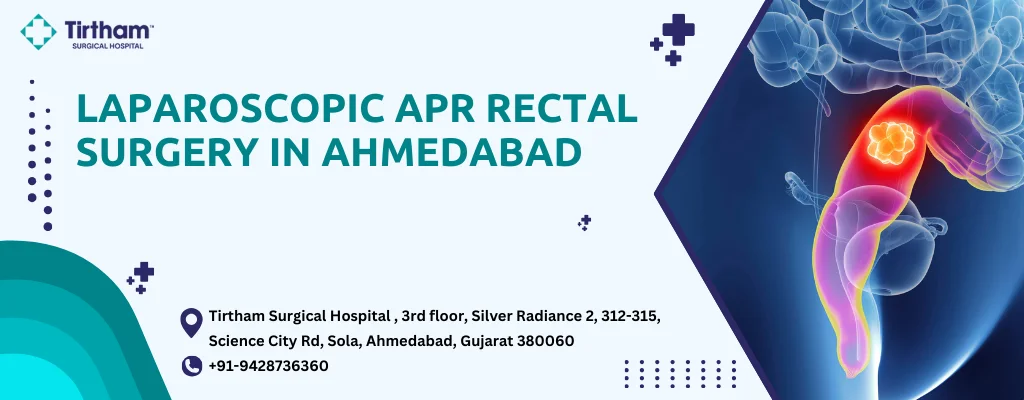
A rectal cancer diagnosis brings one question to the front of most people's minds before any other: will I need a permanent bag? It's the right question to ask, and the honest answer is it depends on where the cancer is. For many rectal cancers, the sphincter (and normal toilet function) can be preserved. For cancers very low down, close to or involving the anal sphincter, an operation called APR which removes the anus and needs a permanent colostomy may be the safest way to cure the cancer.
At Tirtham Surgical Hospital on Science City Road, laparoscopic rectal cancer surgery in Ahmedabad is performed by Dr. Alpesh Patel (MS) as part of a considered, multidisciplinary cancer pathway with the goal of removing the cancer completely while sparing the sphincter wherever it's safe to do so. Below is an honest guide to the two main operations, the stoma question, and the wider treatment involved.
What rectal cancer surgery involves
The core of curative rectal cancer surgery is removing the cancer within its surrounding envelope of tissue using a technique called total mesorectal excision (TME) along with nearby lymph nodes for staging. What differs between operations is whether the anus and sphincter can be kept. That single factor decides whether you have a temporary stoma (or none) versus a permanent one, and it's determined mainly by how close the cancer sits to the sphincter.
APR or sphincter-preserving surgery? The stoma question
This is the heart of it and it's where the current information online often goes wrong. There are two main operations, and they are not the same thing.
| APR (Abdominoperineal Resection) | Anterior resection (sphincter-preserving) | |
| What's removed | Sigmoid colon, rectum AND anus | The cancerous rectal segment; the anus is kept |
| Bowel rejoined? | No the anus is gone | Yes bowel is rejoined (coloanal anastomosis) |
| Stoma | Permanent colostomy (bag for life) | Often a temporary stoma to protect healing, later reversed or none |
| When it's used | Very low cancers involving/too close to the sphincter | When a safe margin below the cancer can be kept |
So APR always means a permanent colostomy, because the anus is removed there's no rejoining. Anterior resection preserves the sphincter and usually avoids a permanent bag. Which one you need depends on the tumour's exact position, not on preference.
Can the sphincter be saved?
Often, yes and modern rectal cancer treatment tries hard to. Two things help: better surgical techniques that allow safe removal closer to the sphincter, and neoadjuvant chemoradiation (chemo plus radiation before surgery), which can shrink and downstage a low tumour enough to turn a planned APR into a sphincter-preserving operation. That's one of the biggest reasons rectal cancer is treated by a team, and why surgery isn't rushed into.
The full treatment journey surgery is one part
Rectal cancer is rarely treated by surgery alone. A multidisciplinary team plans the whole pathway based on the stage.
| Step | What happens |
| Diagnosis & staging | Colonoscopy + biopsy, then MRI of the rectum and CT to map the tumour and check for spread |
| Neoadjuvant treatment | For many mid/low rectal cancers, chemoradiation before surgery to shrink the tumour (and often allow sphincter preservation) |
| Surgery (TME) | APR or sphincter-preserving resection, removing the cancer and lymph nodes |
| Adjuvant treatment | Chemotherapy after surgery for some stages, based on the pathology |
| Follow-up | Regular check-ups, scans and blood tests (CEA) to watch for recurrence |
This is why a Rectal Cancer Doctor Ahmedabad patients consult should be working with oncology and radiology, not planning surgery in isolation.
How the laparoscopic surgery is performed
A Laparoscopic Rectal Cancer Surgeon Ahmedabad patients rely on performs the operation through a few small incisions under general anaesthesia, using a camera and fine instruments to carry out a precise TME freeing the rectum within its mesorectal envelope, dividing the blood supply, removing the cancer with a clear margin and nearby lymph nodes. In sphincter-preserving surgery, the healthy bowel is rejoined (often with a temporary protective stoma); in Laparoscopic APR Rectal Surgery in Ahmedabad, the anus is removed through a perineal incision and a permanent colostomy is fashioned. The keyhole approach generally means less pain, less blood loss and a quicker recovery than open surgery, while following the same cancer-clearance principles.
Life with a colostomy honestly
If you need an APR and a permanent colostomy, it's natural to feel daunted but it's worth knowing that most people adapt well and return to full, active lives, including work, travel and exercise. A stoma nurse teaches you to manage it, and modern appliances are discreet and secure.
| Concern | The honest reality |
| Managing it | A stoma nurse trains you before and after surgery; most become confident within weeks |
| Daily life | People with stomas work, travel, swim and exercise normally |
| Diet | Most eat a near-normal diet, with a few personal adjustments |
| Emotional side | It's a big adjustment — support, stoma-care groups and counselling genuinely help |
A permanent colostomy is a change, not the end of a normal life and when it's what's needed to cure the cancer safely, it's a worthwhile trade.
Recovery and follow-up
After laparoscopic rectal cancer surgery, most people stay in hospital several days to a week while the bowel recovers, then build back up over a few weeks, avoiding heavy lifting during that time. If you have a temporary stoma after sphincter-preserving surgery, it's usually reversed after a few months once healing is confirmed. Follow-up is lifelong-minded and structured: regular clinic visits, blood tests (including CEA), colonoscopy and scans to catch any recurrence early because early detection of a recurrence gives the best chance of treating it.
What laparoscopic rectal cancer surgery costs in Ahmedabad
Cost depends on the operation, your stage, and how much treatment you need beyond surgery. As a guide, rectal cancer surgery itself broadly runs around ₹2,00,000–₹4,00,000 for a laparoscopic resection in Indian private hospitals; the full treatment (with neoadjuvant chemoradiation and any adjuvant chemotherapy) is higher and stage-dependent. These are general market figures, not a fixed Tirtham price — your exact cost depends on your case and cancer treatment is generally covered by cashless mediclaim.
We'll give you a clear, case-specific estimate once your staging and reports are reviewed. Cashless mediclaim is available, and the Tirtham Health Card covers consultations and reports. Share your reports on WhatsApp or contact the team.
Meet your rectal cancer surgeon Dr. Alpesh Patel
Rectal cancer surgery demands both oncological rigour and humanity, clearing the cancer with a proper TME while doing everything possible to preserve normal function, and being honest when a permanent stoma is the safest path. Dr. Alpesh Patel (MS) brings 18+ years of surgical practice and 22,000+ operations, performing laparoscopic rectal cancer surgery within a multidisciplinary cancer pathway.
As a Rectal Cancer Specialist Ahmedabad patients turn to an APR Rectal Cancer Surgeon Ahmedabad who prioritises sphincter preservation where it's safe his approach is honest and team-based: proper staging, coordination with oncology for neoadjuvant treatment, a precise TME, and a clear, supportive conversation about the stoma question before any decision. → More about Dr. Alpesh Patel
Why patients choose Tirtham Hospital
Reasons patients trust this Rectal Cancer Surgery Hospital Ahmedabad:
- Sphincter-sparing wherever safe — the goal is to cure the cancer and preserve normal function where the tumour allows.
- A proper cancer pathway — staging, coordination with oncology for chemoradiation, and TME surgery, at a Rectal Cancer Treatment Hospital Ahmedabad that treats this as team medicine.
- Honest about the stoma — you'll know clearly whether you need a temporary or permanent one, and get full support either way.
- Minimally invasive TME — keyhole surgery with the same cancer-clearance standards as open.
- Cashless mediclaim and a dignified, supported recovery — at a Laparoscopic APR Hospital Ahmedabad that treats the person, not just the tumour.
Frequently asked questions
What is APR, and will I need a permanent stoma?+
APR (Abdominoperineal Resection) removes the sigmoid colon, rectum and anus, so it always requires a permanent colostomy — a stoma for life — because the anus is removed and the bowel can't be rejoined. It's used for very low rectal cancers that involve or sit too close to the sphincter. Many other rectal cancers can be treated with sphincter-preserving surgery instead, avoiding a permanent stoma.
Can my sphincter be saved so I avoid a permanent bag?+
Often, yes. Where a safe margin below the cancer can be kept, sphincter-preserving (anterior resection) surgery rejoins the bowel and avoids a permanent colostomy. Neoadjuvant chemoradiation before surgery can shrink a low tumour enough to make this possible. Whether it's safe depends on the tumour's exact position — your team assesses this carefully with MRI before deciding.
Is surgery the only treatment for rectal cancer?+
No — rectal cancer is usually treated by a team. Many mid and low rectal cancers have chemoradiation before surgery (to shrink the tumour and often allow sphincter preservation), then TME surgery, and sometimes chemotherapy afterwards, based on the pathology. Staging with MRI and CT guides the plan. Surgery is a central part, but rarely the whole treatment.
What is life like with a colostomy?+
Most people adapt well and live full, active lives — working, travelling, swimming and exercising. A stoma nurse trains you to manage it before and after surgery, and modern appliances are discreet and secure. It's a significant adjustment emotionally, and support and stoma-care guidance genuinely help. When a permanent colostomy is what's needed to cure the cancer, most people find life goes on normally.
Will I need chemotherapy or radiation as well as surgery?+
Often, yes, depending on stage. Many mid/low rectal cancers receive chemoradiation before surgery to shrink the tumour and improve outcomes (and to help preserve the sphincter). Chemotherapy after surgery is advised for some stages, based on the pathology results. Your oncology team decides this alongside the surgery — it's all part of one coordinated plan.
What's recovery like after the surgery?+
Most people stay in hospital several days to a week while the bowel recovers, then build up over a few weeks, avoiding heavy lifting. A temporary stoma (after sphincter-preserving surgery) is usually reversed after a few months once healing is confirmed. Follow-up is structured — clinic visits, blood tests, colonoscopy and scans — to catch any recurrence early.
What does laparoscopic rectal cancer surgery in Ahmedabad cost?+
As a general guide, laparoscopic rectal cancer surgery in Ahmedabad runs roughly ₹2,00,000–₹4,00,000 for the operation, with the full treatment (including neoadjuvant chemoradiation and any adjuvant chemotherapy) higher and stage-dependent. Cancer treatment is generally covered by cashless mediclaim. Share your staging and reports for a case-specific estimate.
Who should treat rectal cancer — which Rectal Cancer Surgeon Ahmedabad is right?+
Rectal cancer is best managed by a team — a surgeon working with oncology and radiology — with surgery performed by an experienced colorectal/laparoscopic surgeon. The right Rectal Cancer Surgeon Ahmedabad stages the cancer properly, coordinates neoadjuvant treatment, performs a precise TME, and prioritises sphincter preservation where safe. At Tirtham, Dr. Alpesh Patel (MS) offers this within a multidisciplinary pathway.
Just diagnosed? Let's look at this together
A rectal cancer diagnosis is overwhelming, and you deserve clear, honest information and time to absorb it. Share your colonoscopy, biopsy and MRI/CT reports with us for a considered opinion. We'll explain whether your sphincter can likely be saved, what the full treatment involves, and honestly answer the stoma question. Reach us on call or WhatsApp at +91-9428736360, or talk it through privately with SurgiMitra on +91-9974416665. A second opinion is always welcome. This is a decision worth getting right.
Next step
Plan your procedure
Share your reports on WhatsApp for a guided opinion, or visit us on Science City Road for an in-person examination.