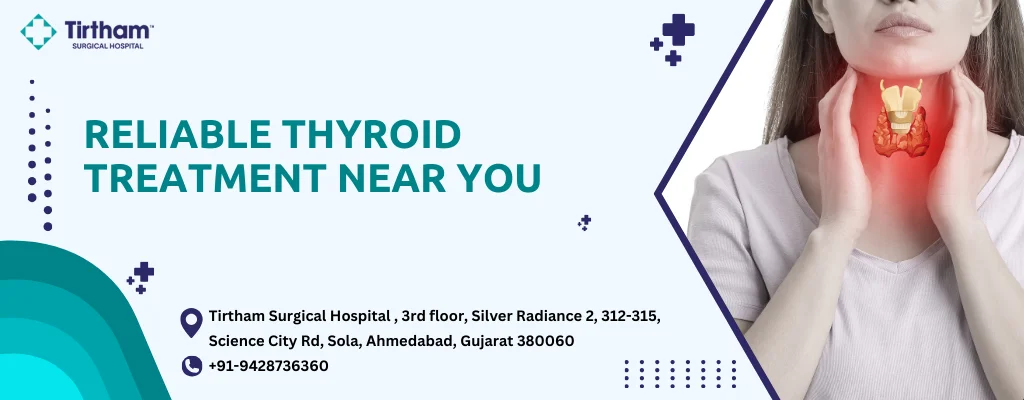
The thyroid is a small, butterfly-shaped gland in the neck that controls your metabolism through the hormones it makes. When it makes too little (hypothyroidism) or too much (hyperthyroidism), or develops a lump (nodule) or enlargement (goitre), it causes a range of symptoms. Here's the clarity most pages miss: the great majority of thyroid problems are managed with tablets and monitoring, not surgery. A surgeon becomes involved for a specific set of situations: a goitre or nodule that's large or suspicious, a cancer, or an overactive thyroid that medicines can't control.
At Tirtham Surgical Hospital on Science City Road, as a thyroid specialist in Ahmedabad focused on the surgical side, Dr. Alpesh Patel (MS) performs thyroid surgery when it's genuinely needed and is honest when your thyroid problem is better managed with medication and monitoring. Below is a clear guide to what's treated with tablets, when surgery is the right call, and whether a nodule could be cancer.
What the thyroid does
The thyroid produces hormones (T4 and T3) that set the pace of your body's metabolism. Too little slows everything down tiredness, weight gain, feeling cold, dry skin, low mood. Too much speeds it up palpitations, weight loss, feeling hot and anxious, sleep trouble. It can also simply enlarge (goitre) or grow a nodule (lump) without necessarily changing your hormone levels. Causes range from autoimmune conditions (Hashimoto's, Graves'), iodine issues and inflammation, to nodules and, occasionally, cancer. Which of these you have determines whether tablets, monitoring, or surgery is right and most are not surgical.
Medical or surgical? What's treated how
This is the honest crossroads that clarifies everything.
| Thyroid problem | Usual treatment |
| Hypothyroidism (underactive) | Tablets thyroid hormone replacement (levothyroxine); no surgery |
| Hyperthyroidism (overactive) | Medicines (antithyroid drugs), radioiodine, or beta-blockers first; surgery if these fail or aren't suitable |
| Small, benign nodule / mild goitre | Monitoring usually just watched |
| Large goitre / nodule with compression | Surgery to relieve pressure |
| Suspicious or cancerous nodule | Surgery (thyroidectomy) |
So if your thyroid problem is a hormone imbalance, it's very likely a tablet-and-monitoring situation, best managed by a physician/endocrinologist. Surgery is for the structural and cancer problems below.
When thyroid surgery is needed
A thyroid surgeon in Ahmedabad recommends thyroid surgery (thyroidectomy) for specific reasons:
| Reason for surgery | Why |
| Thyroid cancer (confirmed or suspected) | Surgery is the primary treatment |
| Large goitre/nodule causing compression | Relieves difficulty swallowing/breathing, hoarseness, or a visible neck swelling |
| A suspicious or indeterminate nodule | When a biopsy can't rule out cancer, removal makes it certain |
| Hyperthyroidism not controlled | When medicines and radioiodine fail or aren't suitable (surgery is >90% effective) |
| Cosmetically troubling enlargement | If a visible goitre bothers you, once benign |
Surgery isn't a first step for a thyroid hormone problem it's for a gland that's dangerously large, structurally troublesome, suspicious, or cancerous.
Is a thyroid nodule cancer?
This is the worry a neck lump brings and the reassuring news is that most thyroid nodules are benign (only a small minority are cancer). But, as with any lump, it's checked properly to be sure. A thyroid doctor in Ahmedabad assesses a nodule with three things together:
| Step | What it shows |
| TSH blood test | Whether the nodule is affecting hormone levels |
| Ultrasound of the neck | The nodule's size and features (and any suspicious signs) |
| FNAC (fine-needle biopsy) | A cell sample to tell benign from suspicious |
Most nodules turn out benign and simply need watching. Surgery is for nodules that are suspicious on biopsy, large/compressing, or growing so assessment spares the majority an unnecessary operation while catching the few that matter.
The operation and its honest risks
Thyroid surgery is done under general anaesthesia through a small, neat incision at the base of the neck. Depending on the problem, a lobectomy (one lobe for a single nodule) or a total thyroidectomy (the whole gland for cancer or widespread disease) is performed, sometimes with removal of nearby lymph nodes for cancer.
Being honest about the specific risks (which are uncommon in experienced hands): the voice nerve (recurrent laryngeal nerve) runs right beside the thyroid, so temporary hoarseness can occur and is usually short-lived; and the parathyroid glands (which control calcium) sit alongside, so calcium can dip after surgery needing temporary supplements in some cases (a small percentage need them longer-term). A careful surgeon protects both structures deliberately. You'll be told exactly what to expect.
Will I need tablets for life afterward?
It depends on how much is removed. After a total thyroidectomy, yes you'll take a daily thyroid hormone tablet (levothyroxine) for life to replace what the gland made; it's a simple, once-daily tablet, and levels are checked periodically. After a lobectomy (one lobe left in place), many people keep enough function to need no tablets, or a low dose your surgeon will advise based on your case.
Recovery after thyroid surgery
Recovery from thyroid surgery is usually quicker than people expect often a short hospital stay of a day or two, with most returning to normal activities within one to two weeks. There's a small, neat neck incision that heals into a fine scar (often within a natural skin crease), some mild neck stiffness or a sore throat for a few days, and calcium and hormone levels checked as needed. You'll get clear advice on wound care, activity, and your medication (if any). Most people are pleasantly surprised by how straightforward it is.
Thyroid cancer a reassuring word
If a nodule turns out to be thyroid cancer, here's the genuinely hopeful truth: most thyroid cancers are very treatable, with excellent outcomes; the common types (papillary and follicular) generally respond very well to surgery, sometimes followed by radioiodine, with high cure rates. Treatment is planned by a coordinated team (surgery plus endocrinology and, for radioiodine, nuclear medicine). A thyroid-cancer diagnosis is frightening, but it's one of the more treatable cancers, which is why prompt, proper assessment of a nodule matters and usually brings reassurance rather than bad news. → Cancer surgery
What thyroid surgery costs in Ahmedabad
Cost depends on the operation (lobectomy vs total thyroidectomy) and whether it's for benign disease or cancer. As a general market range, thyroid surgery in Ahmedabad runs roughly ₹40,000–₹1,50,000, with cancer surgery (and any additional treatment like radioiodine) at the higher end. Medical management of hormone problem tablets and monitoring costs far less and is often all that's needed. These are market figures, not a fixed Tirtham price, and medically indicated thyroid surgery is generally covered by cashless mediclaim.
We'll advise honestly whether you need surgery at all, and give a case-specific estimate if you do. Cashless mediclaim is available, and the Tirtham Health Card covers consultations and reports. Share your reports on WhatsApp or reach the team.
Meet your thyroid surgeon Dr. Alpesh Patel
Thyroid surgery rewards precision and honesty, protecting the voice nerve and calcium glands, removing exactly what's needed, and being straight about when surgery isn't required at all. Dr. Alpesh Patel (MS) brings 18+ years of practice and 22,000+ surgeries, performing thyroidectomy for goitre, nodules and cancer.
As a thyroid specialist in Ahmedabad on the surgical side, his approach is measured: assess a nodule properly (ultrasound + FNAC), reassure and monitor where surgery isn't needed, and when it is perform a careful thyroidectomy that protects the voice and calcium glands, coordinating multidisciplinary care for thyroid cancer. → More about Dr. Alpesh Patel
Why patients choose Tirtham
Reasons patients trust this thyroid hospital in Ahmedabad:
- Honest medical-vs-surgical advice — no surgery for a hormone problem that tablets manage.
- Careful thyroidectomy — the voice nerve and calcium glands protected, with a neat neck scar, at a thyroid surgery hospital in Ahmedabad built for it.
- Nodules assessed properly — ultrasound and FNAC to reassure the majority and catch the few that matter.
- Coordinated cancer care — a proper multidisciplinary pathway when it's needed, at a thyroid treatment hospital in Ahmedabad that thinks beyond the operation.
- Cashless mediclaim and clear, honest guidance throughout.
Frequently asked questions
Does thyroid disease always need surgery?+
No — the great majority doesn't. Hormone problems (an underactive or overactive thyroid) are usually managed with tablets, radioiodine and monitoring, not surgery. Thyroid surgery is for specific situations: cancer, a large goitre or nodule causing compression, a suspicious nodule a biopsy can't clear, or hyperthyroidism that medicines and radioiodine can't control. Most people with a thyroid condition never need an operation.
When is thyroid surgery needed?+
Thyroid surgery is recommended for confirmed or suspected thyroid cancer, a large goitre or nodule pressing on the windpipe or food pipe (causing difficulty swallowing, breathing, or hoarseness), a suspicious or indeterminate nodule, or an overactive thyroid that doesn't respond to medicines or radioiodine. Your surgeon reviews your symptoms, blood tests, ultrasound and biopsy before recommending it.
Is a thyroid nodule cancer?+
Usually not — most thyroid nodules are benign, and only a small minority are cancer. A nodule is assessed with a TSH blood test, a neck ultrasound, and often an FNAC (fine-needle biopsy) to tell benign from suspicious. Most turn out benign and just need monitoring; surgery is for nodules that are suspicious on biopsy, large or compressing, or growing.
What are the risks of thyroid surgery?+
The two specific risks are temporary voice change/hoarseness (the voice nerve runs beside the thyroid) and a dip in calcium (the parathyroid glands sit alongside) — permanent calcium need affects around 1% and temporary about 5%. Both are uncommon in experienced hands, as the surgeon deliberately protects these structures. There's also a small, neat neck scar. Serious complications are rare.
Will I need tablets for life after thyroid surgery?+
It depends on how much is removed. After a total thyroidectomy, yes — a simple once-daily thyroid hormone tablet (levothyroxine) for life, with levels checked periodically. After a lobectomy (one lobe left), many people keep enough function to need no tablets or only a low dose. Your surgeon advises based on your operation and follow-up blood tests.
Is thyroid cancer serious?+
A diagnosis is frightening, but most thyroid cancers are very treatable with excellent outcomes — the common types (papillary and follicular) respond very well to surgery, sometimes with radioiodine, and have high cure rates. It's one of the more treatable cancers. This is exactly why getting a nodule assessed promptly matters — and usually brings reassurance rather than bad news.
What does thyroid surgery in Ahmedabad cost?+
As a general range, thyroid surgery in Ahmedabad runs roughly ₹40,000–₹1,50,000, with cancer surgery and any additional treatment (like radioiodine) at the higher end. Managing a hormone problem with tablets and monitoring costs far less and is often all that's needed. Medically indicated surgery is generally covered by cashless mediclaim. We give a case-specific estimate after assessment.
Who is a good thyroid specialist in Ahmedabad?+
A good thyroid specialist in Ahmedabad is honest about when surgery is (and isn't) needed, assesses nodules properly, and — when operating — protects the voice nerve and calcium glands with a neat result. On the surgical side, Dr. Alpesh Patel (MS) — 18+ years and 22,000+ surgeries — provides careful thyroidectomy for goitre, nodules and cancer, coordinating with physicians for medical management.
A neck lump or thyroid question? Let's clarify it
Whether you have a thyroid hormone problem, a neck swelling, or a nodule you're worried about, the first step is a clear, honest assessment and often the answer is reassuring, with no surgery needed. Share your reports (thyroid blood tests, ultrasound, or biopsy) with us for a guided opinion, and we'll tell you honestly whether it's a tablets-and-monitoring situation or one where surgery genuinely helps. Reach us on call or WhatsApp at +91-9428736360, any time.
Next step
Plan your procedure
Share your reports on WhatsApp for a guided opinion, or visit us on Science City Road for an in-person examination.